


Most of us only think about data centres when something goes wrong. The banking app will not load, the video call drops in the middle of a meeting, or an online shop freezes just as you reach the checkout. Behind each of those services sits a building full of machines that has to stay switched on every hour of every day. Keeping it that way takes far more than a room of computers. This article looks at the infrastructure that keeps modern data centres running and why power sits at the heart of it all.
Why Data Centres Matter More Than Ever
A data centre is a facility that houses the servers which store and process information for cloud computing, websites, online platforms and business applications. When you save a photo to the cloud, stream a film or use an app built through the process described in our guide to software development, the work is happening on servers in a data centre somewhere. The rise of the Internet of Things adds even more, as billions of connected devices send data that needs to be stored and processed.
Their importance is now recognised at government level. In September 2024, the UK government classed data centres as Critical National Infrastructure, placing them alongside energy and water systems.
Demand is also growing quickly. The International Energy Agency estimates that data centres used around 415 TWh of electricity in 2024, about 1.5% of global consumption, and its Energy and AI report expects that figure to more than double to around 945 TWh by 2030, slightly more than Japan uses in a year today.
The Core Building Blocks of a Data Centre
Servers and Storage
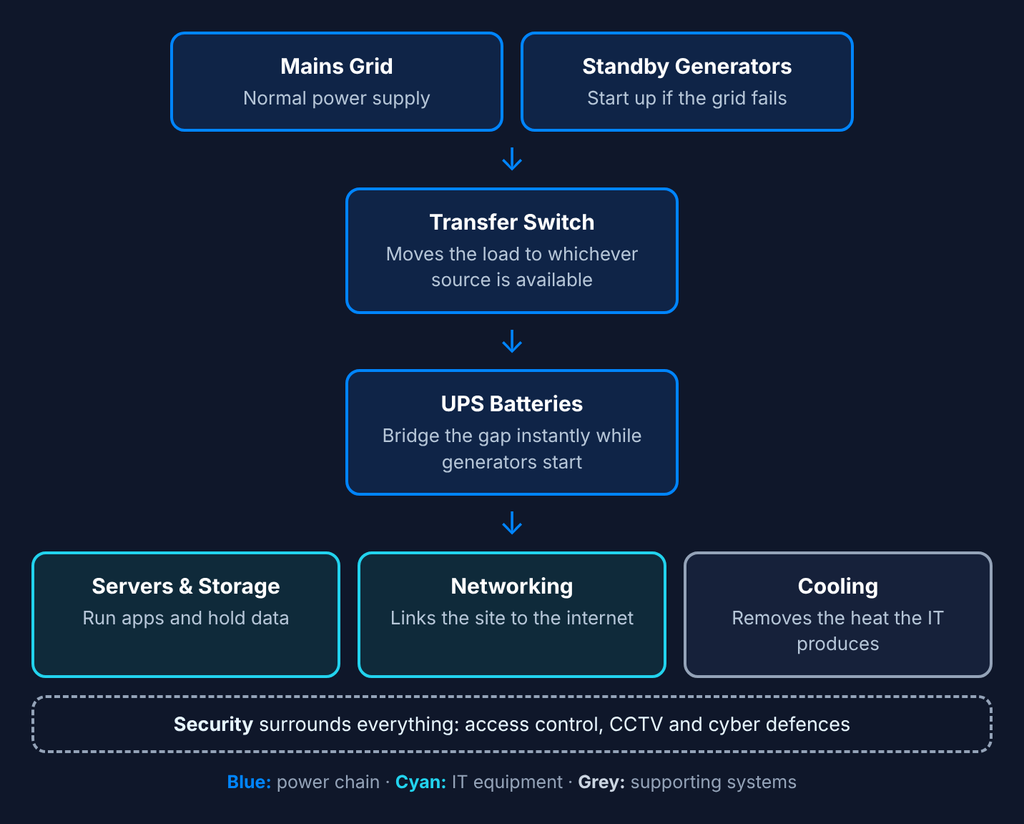
Servers are the computers that do the actual work, running applications and handling requests from users. According to the IEA, they account for around 60% of the electricity used in modern data centres. Storage systems, which hold the data itself, use about 5%.
Networking and Connectivity
Switches, routers and fibre-optic cables connect the servers to each other and to the outside world. Most facilities connect to several network providers, so a single damaged cable does not cut the site off. Networking equipment uses up to 5% of a data centre’s electricity, according to the same IEA analysis.
Cooling Systems
Almost all the electricity a server uses ends up as heat, and that heat has to go somewhere. Data centres use chilled air, carefully arranged hot and cold aisles and, increasingly, liquid cooling for powerful AI chips. The IEA notes that cooling can take anywhere from about 7% of a site’s electricity in efficient large facilities to over 30% in less efficient ones.
Physical and Digital Security
Security covers both the building and the data inside it. Sites typically use perimeter fencing, CCTV, on-site staff and controlled access to server rooms. Digital protection matters just as much, and the principles in our guide to cybersecurity apply on a much larger scale here.
How a Data Centre’s Systems Work Together
Why Power Is the Foundation of Everything
Every system described above depends on a steady supply of electricity. If the power stops, the servers stop, and so does the cooling. Without cooling, any equipment still running can overheat in a matter of minutes.
An unexpected interruption can mean websites and apps going offline, transactions failing part-way through and data being corrupted if servers shut down without warning. Bringing everything back up safely also takes time, so the disruption often lasts longer than the power cut itself. The Uptime Institute’s Annual Outage Analysis 2026 found that power remains the leading cause of impactful outages, and 57% of operators it surveyed said their most recent major outage cost more than $100,000.
How Backup Power Keeps Things Running
Data centres protect themselves with layers of backup. The first layer is the uninterruptible power supply, or UPS, a bank of batteries that takes over the moment the mains supply drops. It only needs to last long enough for the second layer, standby generators, to start up. A transfer switch then moves the load across to the generators, which can keep the site running on stored fuel until the grid comes back. Many facilities also duplicate key equipment and run two separate power paths, so one failed component does not bring everything down.
Having this equipment in place is only part of the picture. The Uptime Institute’s 2024 outage analysis reported that four in five operators believed their most recent serious outage could have been prevented with better management, processes and configuration. That is why operators regularly test their generators under realistic load rather than simply switching them on for a few minutes, and keep maintenance records for every part of the power chain. Many work with specialist firms for this side of the operation, and WBPS data centre power services, for example, cover generators, UPS systems and their ongoing maintenance.
Why the Apps You Rely On Rarely Go Dark
The next time an app loads instantly or a file appears in the cloud without a second thought, it is worth remembering the work happening out of sight. Servers, networks, cooling and security all play their part, but none of them can do anything without reliable electricity. As demand for computing keeps rising, the backup systems and careful planning that keep the power flowing will only become more important to the digital services we use every day.

